The personality assessment your team takes matters.
What your team does with it Monday morning matters more.
I was reminded of that recently, at my own expense.
I took the 5 Voices leadership assessment for the first time. My results said my foundational voice is Guardian, the champion of systems, processes, and due diligence. My secondary voice is Creative.
And my “nemesis” voice? Connector. The voice of networking and relational communication.
For a guy who makes his living standing in front of rooms full of strangers, that one made me laugh. Then it made me think.
As I read through the report, something else jumped out.
A lot of it sounded familiar.
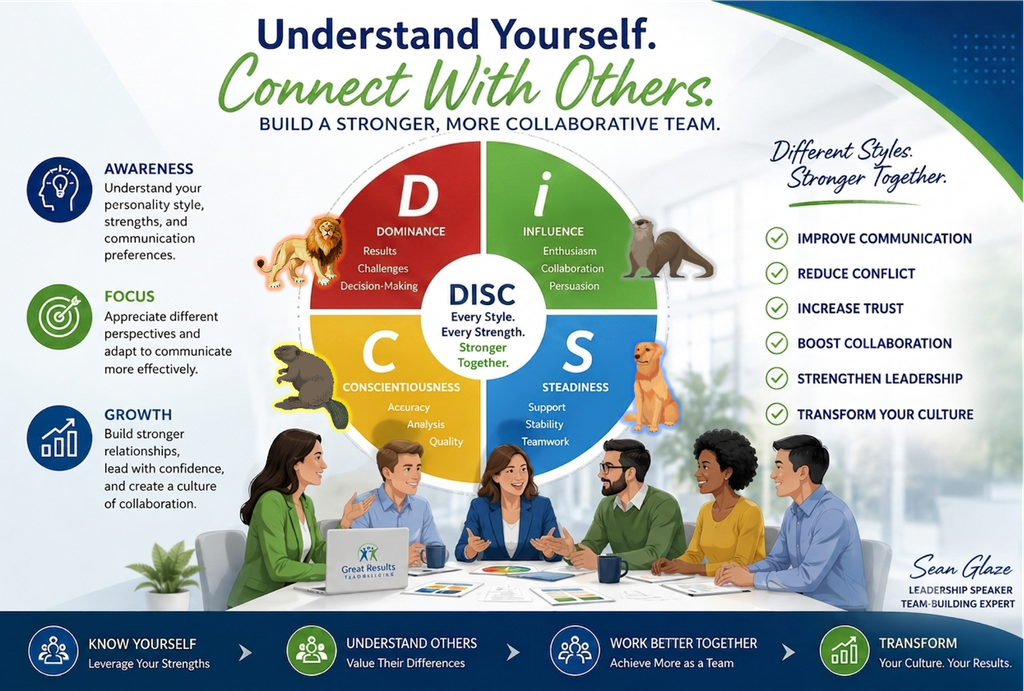
The Guardian sounded a whole lot like the C style in DISC, the analytical Beaver in my animal styles. The Pioneer sounded like a Lion. The Connector sounded like an Otter.
If you’ve sat through a few of these with your team, you’ve probably felt the same thing. Different letters.
Different colors.
Different animals.
Same people.
That’s not a flaw. It’s actually pretty good news. Here’s why.
Why They All Seem to Rhyme
Almost every popular personality tool is answering some version of the same two questions:
- Do you lean toward tasks or people?
- Do you move assertively, or deliberately?
Put those two questions on a grid and you get four quadrants.
DISC lives right there. People were sorting each other into four temperaments long before any of us were filling out online surveys.
The tools differ in what they stack on top.
Some focus on motivation. Some focus on talent.
Some focus on how you contribute in a meeting.
But underneath, they keep circling the same handful of patterns.
When five different tools keep landing on the same patterns, the patterns are worth your attention. The real question isn’t which tool is right.
It’s which one your team will actually use.
What Each Test Does Best
Here’s my quick take on five tools that show up often in corporate training rooms: what each one does well, where it falls short, and how to use it to change the way your team communicates.
1. MBTI (Myers-Briggs Type Indicator)
What it is: Developed by Katharine Cook Briggs and her daughter, Isabel Briggs Myers, building on Carl Jung’s ideas about psychological type. It sorts people into 16 four-letter types, like ENFP or ISTJ.
What it does best: It gives people a vocabulary for how they recharge, take in information, and make decisions. The introvert and extravert conversation alone has helped plenty of teams stop misreading their quietest members.
What to watch: Research psychologists have criticized its reliability for decades. One frequently cited review reported that as many as half of people landed in a different type when they retook it just five weeks later. Treat your four letters as the start of a conversation, not a permanent label.
Use it to change behavior: Ask each person, “Do you prefer to work through a big decision out loud in the meeting, or on your own first?” Then build meetings that respect both. Send the agenda early. Leave room for a follow-up decision.
2. The Enneagram
What it is: Nine types, each built around a core motivation and a core fear. The modern version traces mainly to Oscar Ichazo and Claudio Naranjo, though its deeper origins are debated.
What it does best: It goes below behavior to the why. Two teammates can both be relentless perfectionists for completely different reasons. One needs to be right. The other needs to feel valued. The Enneagram helps people see that difference.
What to watch: It has much less scientific support than the other tools here, and it can get personal fast. A workplace session that digs into people’s deepest fears needs a skilled facilitator and real trust in the room.
Use it to change behavior: Have each person finish one sentence for the team: “When I’m stressed about letting you down, here is what it looks like.” That single sentence prevents a lot of misread moments.
3. CliftonStrengths
What it is: Gallup’s assessment, built on the work of psychologist Don Clifton. It ranks 34 talent themes such as Achiever, Empathy, and Strategic. Gallup reports the assessment has been completed more than 30 million times.
What it does best: Positive language. Instead of labeling what you are, it names what you’re naturally good at. That makes it a strong tool for role design and delegation.
What to watch: With 34 themes, people tend to remember their own top five and nobody else’s. It’s harder to pull out in the middle of a tense conversation.
Use it to change behavior: Build a one page team strengths map and pull it out every time you assign a project. “Who on this team leads with Strategic? Let’s get them in the room early.”
4. The 5 Voices
What it is: Created by Jeremie Kubicek and Steve Cockram of GiANT and laid out in their 2016 book, 5 Voices. It identifies five leadership voices (Pioneer, Connector, Creative, Guardian, and Nurturer) and ranks them in your personal order.
What it does best: The ordering. Knowing your “nemesis” voice explains a lot about which conversations drain you and which teammates frustrate you. It’s also built around making sure every voice on a team gets heard, not just the loudest ones.
What to watch: It describes how you contribute more than how you come across, so it’s harder to spot someone else’s voice from across the table.
Use it to change behavior: Before any big decision, ask one question out loud: “Whose voice haven’t we heard yet?” Then wait for it.
5. DISC
What it is: Based on the work of psychologist William Moulton Marston, who described four behavioral styles in his 1928 book, Emotions of Normal People. (Fun fact: Marston also created Wonder Woman.) Marston built the theory. Later practitioners built the questionnaires.
What it does best: It describes observable behavior. You can spot a fast moving, bottom line D across the conference table and adjust in real time. That’s why I use it in my team personality style programs. I translate the four styles into animals: Lion (D), Otter (I), Retriever (S), and Beaver (C).
People remember animals. They forget letters.
What to watch: Like any self-report tool, it captures how you see yourself right now. And it was never built to predict job performance. Even some DISC publishers advise against using it for hiring.
Use it to change behavior: Flex before you speak:
- Lion: Lead with the bottom line. Give options, not lectures.
- Otter: Lead with energy and the big picture. Let them talk it out.
- Retriever: Lead with how it affects people. Give them time to process.
- Beaver: Lead with data and details. Expect good questions, and welcome them.
The best assessment is the one your team can remember and use in the moment, not the one with the most impressive report.
A Quick Comparison Chart
| Assessment | The question it answers best | Easy to use? |
| MBTI | How do I recharge and decide? | Not really |
| Enneagram | Why do I do what I do? | Not really |
| CliftonStrengths | What am I naturally good at? | Somewhat |
| 5 Voices | How do I contribute, and whose voice is missing? | Somewhat |
| DISC | How do I come across, and how should I adapt? | Yes |
The last column is my opinion from years as a teamwork speaker and facilitator, not a research finding.
Four Things That Turn Assessments Into Teamwork
The tool is the easy part.
Here’s what actually changes behavior.
1. Build a Shared Language
A team that can say “I’m in full Lion mode right now, slow me down” can settle in ten seconds what used to take a tense meeting.
Shared words make it safe to name what is happening.
2. Learn What It Is Like on the Other Side of You
Your style is your intent. Your impact is what your teammates experience.
The real value of any assessment is seeing yourself the way the people across the table see you.
3. Adapt Instead of Label
“That’s just how I am” is the fastest way to waste an assessment.
Your style explains your behavior. It doesn’t excuse it. Great teammates flex toward the people they are talking to.
4. Reinforce It Until It Sticks
A one time workshop fades by the next quarter.
Teams that revisit their team personality style tests in 1:1s, meetings, and project kickoffs keep the awareness alive. Intentional experiences shift awareness, and awareness is what changes behavior
A Lesson From My Nemesis
Learning that Connector is my nemesis voice didn’t change who I am. It gave me a name for something I already felt, and a reason to be more intentional about it.
That’s what a good assessment should do for your team.
Not to put people in boxes.
But to give them an understanding of default tendencies.
And a better way to talk about the differences that were already there.
If your team has taken one of these assessments (or all five of them) and nothing really changed with how you communicate, I’d love to help fix that.

Sean Glaze is a teamwork keynote speaker and team building event facilitator who spent 20 years coaching basketball before transitioning to corporate speaking. He has worked with organizations including Cisco, John Deere, CDC, Emory University, and Southern Company, helping teams build accountability, trust, and stronger collaboration.
He is the author of several leadership books including Rapid Teamwork, What Effective Leaders Do, and The 10 Commandments of Winning Teammates, and he built the G.R.E.A.T. Culture Model, a framework leaders use to diagnose and strengthen team dynamics.

The Interaction Matrix for Team Leaders – How to Make Your Communication Both Compelling and Considerate

How Effective Leaders Create a Culture Where People Feel Like They Matter

From Skeptic to Strategist How to Stop Wasting Time on AI and Start Using It to Grow Your Business

The 4 AI Usage Levels of Business Owners – From Chats to Digital Workforce
Books and Resources for Leaders


Check other blog
The Interaction Matrix for Team Leaders – How to Make Your Communication Both Compelling and Considerate
How Effective Leaders Create a Culture Where People Feel Like They Matter

From Skeptic to Strategist How to Stop Wasting Time on AI and Start Using It to Grow Your Business
Contact Sean

Connect with Sean
Tell Sean About
Your Event


Tell Sean About
Your Event
"*" indicates required fields