
Lisa runs a successful small business.
She is not behind. She is not struggling.
But she is busy.
And lately, everywhere she turns, people are talking about AI.
She tried it. Asked it to write a few emails. Brainstorm a social post. Summarize a meeting. Every time, the results felt inconsistent. Sometimes helpful. Sometimes generic. Always needing edits.
So she did what most business owners do. She quietly moved on and figured AI was overhyped.
Here is the thing. Lisa was not wrong about the output. She was wrong about the reason. The problem was never the technology. The problem was how she was using it.
A 2024 Microsoft survey found that 75% of knowledge workers use AI at work.
Yet only 10% report meaningful productivity gains. That gap tells you everything.
The vast majority of business owners typing into ChatGPT are getting results so generic they could have written it themselves in less time.
If that sounds familiar, you are in the majority.
And the cost of staying there is bigger than you think.

Why “Just Start Using AI” Is Bad Advice
Most of the guidance out there for business owners boils down to the same three suggestions: sign up for ChatGPT, watch some YouTube tutorials, and experiment. That sounds reasonable until you realize it produces random results.
Random inputs produce random outputs. When you open a chat window with no structure, no business context, and no clear objective, the AI has nothing to work with. It defaults to generic content that sounds like it was written by a committee.
That is exactly where Lisa was stuck. She was asking AI casual questions and getting casual answers. No business context. No saved prompts. No system.
The other popular approach is buying AI tools. CRM plugins, social media schedulers, content generators. The tools are fine. The problem is that tools without a system are expensive distractions. You end up paying monthly subscriptions for software you barely use because nobody showed you how to connect it to an actual workflow.
The real issue is not access to AI.
The real issue is implementation.
Every business owner in America has access to the same AI tools right now. Access is commoditized. What separates the owners saving 5 to 10 hours per week from the ones still copying and pasting generic outputs is a system for using AI with intention.
At AI System BOOST, we see this play out every week. Business owners fall into four distinct levels of AI usage, and understanding where you sit changes everything about how you move forward.
The 4 Levels of AI Usage in Your Business
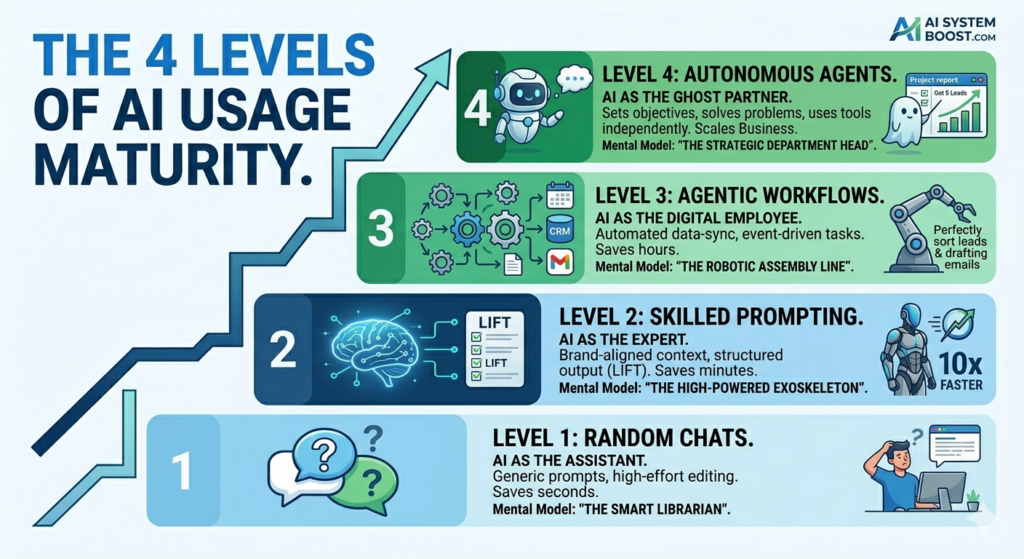
Level 1: Random Chats. You open ChatGPT, type a question, get an answer, and do most of the work yourself. There is no business context. No saved prompts. No consistency. This is where 80% of business owners live. The AI acts like a search engine with better grammar, and the ROI is close to zero. This is where Lisa was. This is where you might be right now.
Level 2: Skilled Prompting. You give AI a specific role, your actual business data, a clear objective, and a defined output format. At AI System BOOST, we teach this through the L.I.F.T. Framework (Lens, Intent, Facts, Target). The difference is dramatic.
This is where everything changed for Lisa. Instead of casually asking for help, she learned to give AI a clear role to play, real context from her business, a defined objective, and a specific output format. A prompt that used to take 30 minutes of rewriting now produced usable output in five minutes. For the first time, AI stopped feeling like a novelty and started functioning as leverage.
Level 3: Agentic Workflows. AI connects to your business tools and runs tasks automatically. New leads get organized and receive personalized follow ups without you touching anything. Meeting notes become action items. Content briefs become draft posts.
Lisa started building simple systems at this level. Leads were automatically organized and responded to. Follow ups happened without her remembering. Content ideas turned into drafts without starting from scratch. She did not hire anyone new, but her operations ran like she did. That is when she got her time back.
Level 4: Autonomous Agents. AI pursues business goals independently, making decisions and adjusting its approach based on context. This level is emerging and powerful, but it is not where most small businesses should start. Jumping to Level 4 without Levels 2 and 3 in place is how leaders waste money and give up entirely.
Why Levels 2 and 3 Deliver the Biggest ROI
Three things matter here.
First, time savings. Business owners who implement structured prompting (Level 2) consistently cut content creation, email drafting, and proposal writing time by 60% to 80%. A task that took an hour drops to 10 or 15 minutes. Across a full week, that reclaims 5 to 10 hours.
Second, consistency. Random prompting produces outputs that vary wildly in quality. Structured prompting with your brand voice, your pricing, and your client language baked in produces outputs you can actually use without a full rewrite.
Clients we audit typically go from using 20% of their AI generated content to using 80%.
Third, scalability. Agentic workflows at Level 3 let you systematize tasks that previously required you or an employee. Follow up sequences run on their own. Onboarding documents generate from templates. SOPs build themselves from process recordings. You stop being the bottleneck.
Two Objections You Are Probably Thinking
“I have tried AI and it was not that impressive.” Lisa thought the same thing. If you used it at Level 1, you are right. Level 1 is unimpressive. The mistake is judging the technology by its lowest implementation. That is like judging email marketing by one blast you sent with no subject line and no segmentation. The tool is not the problem. The system is.
“My business is too specialized for AI to understand.” This is the most common objection we hear and the easiest to disprove. The L.I.F.T. Framework exists precisely for this. When you feed AI your specific data, your industry terminology, your client profiles, and your unique positioning, the outputs reflect that specificity.
We have built systems for contractors, consultants, coaches, real estate agents, accountants, and agencies. Every one of them said their business was different. Every one of them was right. And the AI handled it because the system handled the context.
What Changes When You Move Up
If you stay at Level 1, you will continue to feel like AI is overhyped. You will keep editing generic content and wondering if the technology is worth the effort.
If you move to Level 2, you will produce better content, proposals, emails, and sales materials in a fraction of the time. Your brand voice stays consistent. Your outputs need less editing. Your workload drops.
If you build Level 3 systems, entire workflows run without your involvement. Leads get followed up on. New hires onboard faster. Your sales pipeline moves without you manually pushing every deal forward.
The gap between business owners operating at Level 1 and those at Levels 2 and 3 is already wide. It grows every month. Lisa saw it happening around her before she made the shift. The business owners who seemed to be getting ahead were not smarter. They had a better system.
Your Next Step
Lisa did not figure this out by guessing. She stepped back and asked a better question: “Where would AI actually make a difference in my business?”
You can answer that question today.
The AI Business BOOST Audit is a 90 minute deep dive into your business across five critical areas: Branding, Operations, Organizational Knowledge, Sales, and Training. You walk away with a prioritized roadmap showing exactly which AI systems to build first, ranked by impact and ease of implementation.
No jargon. No generic advice. A specific plan built around your business.
Visit www.AISystemBOOST.com to schedule your AI Business BOOST Audit today.

How Effective Leaders Create a Culture Where People Feel Like They Matter

The 4 AI Usage Levels of Business Owners – From Chats to Digital Workforce

How Smart Leaders Reclaim 10 Hours a Week with an AI System BOOST

The 3 Essential Behaviors That Build Trust and Drive Team Productivity
Books and Resources for Leaders


Check other blog
How Effective Leaders Create a Culture Where People Feel Like They Matter
The 4 AI Usage Levels of Business Owners – From Chats to Digital Workforce
How Smart Leaders Reclaim 10 Hours a Week with an AI System BOOST
Contact Sean

Connect with Sean
Tell Sean About
Your Event


Tell Sean About
Your Event
"*" indicates required fields