
Nice Is Not the Same as Effective
Being nice and being effective are two different skills. So are being direct and being harsh.
I have watched leaders confuse them for years. The kind ones avoid the hard conversation to protect the peace. The blunt ones deliver the hard conversation and leave a mess behind. Both believe they are doing the right thing.
Here is the idea that sorts it out.
Leadership is the influence that our interactions have on others.
Not your title. Not your vision statement.
Your conversations, your emails, and your meetings, one at a time.
Ask people about the best leader they ever had and they almost never talk about big personalities or big wins. They talk about small daily moments when that leader truly saw them, heard them, and valued them. That is why the Interaction Matrix is so valuable. It helps you to identify what you tendency is in those small interactions where your leadership happens – and awareness is the key to improvement!
The Interaction Matrix
In my book, What Effective Leaders DO, I share a simple tool that shows you which kind of conversation you are really having.
It measures two things:
- Considerate: how much effort you put into being kind and polite.
- Compelling: how well your words move people to take action.
Cross them and you get four quadrants.
Every conversation you have lands in one of them.
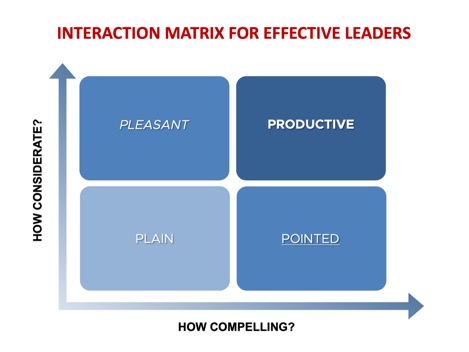
Each one contains phrases you have probably said, heard, or typed…
Plain: No Care, No Direction
What it sounds like
- “Not my problem.”
- “I don’t care.”
- “Why am I even here?”
Plain is not always loud. It is also the email you never answered, the meeting you canceled with no explanation, and the one word reply that says nothing at all.
What it costs you
Silence is an interaction too, and your team will fill in the meaning for you.
They rarely guess kindly. When you give people no care and no direction, they assume the worst and quietly stop bringing you their best.
Pointed: Clear, but It Leaves a Bruise
What it sounds like
- “That’s not my job.”
- “This is a terrible idea.”
- “Stop interrupting me.”
Pointed leaders often see themselves as efficient.
And the message does land.
The other person knows exactly what you want. They also know exactly how you feel about them.
What it costs you
Early in my coaching career, I had the standards right and the delivery wrong.
My accountability was often resented, and I understand why now.
I would love a do over of my first year as a head coach. Our players would have had more success, both in their relationships and on the scoreboard.
People comply with pointed leaders, then they avoid them.
You get the task done once and lose the conversation next time.
Pleasant: Kind, but Foggy
What it sounds like
- “Sure, I can squeeze that in.” (when you cannot)
- “Interesting idea!” (when you have serious doubts)
- “No worries, go ahead.” (when you were just talked over again)
Pleasant feels safe, and that is the trap. It protects the relationship today and drains it later.
What it costs you
Your yes turns into resentment. Your praise turns into noise. And the problem you never named keeps growing. Kindness without a clear ask is avoidance with good manners.
Productive: Kind and Clear
This is the quadrant to aim for. It is considerate and compelling in the same breath.
You protect the person and you protect the point.
Picture this. A colleague drops a request in your lap that is not yours.
Your first instinct is “That’s not my job,” which is pointed.
Saying “Sure, no problem” and resenting it all weekend is pleasant.
Letting the message sit unanswered is plain.
Productive sounds different, and it is not hard to learn.
Here is what all nine phrases sound like when you adjust them:
| Quadrant | Instead of | Try this |
| Pointed | “That’s not my job.” | “Thanks for thinking of me. This is outside what I’m covering right now. If it’s the priority, let’s decide together what I should set down to make room.” |
| Plain | “Not my problem.” | “Thanks for flagging this. It looks closer to the finance team’s area. Want me to connect you with them?” |
| Plain | “I don’t care.” | “I’ll fit this in based on urgency and impact. What’s riding on it for you?” |
| Pointed | “This is a terrible idea.” | “I see what you are going for. What risks have we looked at, and what other options did we weigh?” |
| Plain | “Why am I even here?” | “Help me understand where you need me in this meeting, so I can contribute where it counts.” |
| Pointed | “Stop interrupting me.” | “Let me finish this thought, then I’d love to hear yours.” |
| Pleasant | “Sure, I can squeeze that in.” | “I can take that on if the budget report moves to next week. Which one matters more to you?” |
| Pleasant | “Interesting idea!” | “I like where you’re headed. The part that worries me is the timeline. Can we look at it together?” |
| Pleasant | “No worries, go ahead.” | “I wasn’t finished, so let me wrap up in thirty seconds, then I want to hear your view.” |
Notice that none of these are soft.
The first one still protects your workload. It just does it in a way that keeps the person who asked on your side.
One caution. Do not memorize these lines and recite them.
People can hear a script from across the room. Use your own words, and borrow the pattern instead.
The pattern is what makes the conversation work.

The Adjustments That Get You There
Every rewrite above follows the same pattern.
Two adjustments raise how considerate you are. Two raise how compelling you are.
To be more considerate
- Keep your point and lower the heat. The message stays the same. The temperature drops.
- Describe the issue, not the person. “The timeline has a gap” lands very differently than “You never plan ahead.”
To be more compelling
- End with a next step or a question. Give the other person something to do or something to answer.
- Be calm and specific. “Soon” is not a deadline. “Thursday at noon” is.
In my leadershp parable, a mentor character named Tony keeps an adjustable wrench in his back pocket.
It reminds him that the leader’s job is to adjust to the person in front of them, instead of waiting for that person to adjust first.
Productive conversations rarely happen by accident.
They happen when someone is willing to adjust.
Try This Before Friday
Before you send the next tense email or walk into the next tough conversation, ask two questions:
- Is this considerate?
- Is this compelling?
If either answer is no, rewrite one sentence.
Just one.
That small adjustment, repeated across a week of conversations, is how culture starts to change.
Start with the conversation you have been dreading.
It is usually a pointed one or a plain one, and it is usually where a single adjusted sentence helps the most. You do not need a perfect script.
You need to pause long enough to choose your words.
Then take it to your team. Ask them where they would place your last meeting on the matrix. The answer may sting. It will also be some of the most useful feedback you get this quarter.
Want your leaders practicing this live?
This is exactly what I help people do better in my keynotes, team building events, and one on one leadership coaching.
The matrix is simple.
Using it when the pressure is on takes practice.
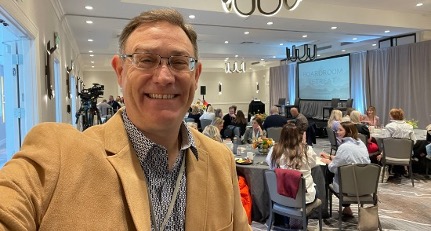
Sean Glaze is a workplace culture keynote speaker and team building event facilitator who spent 20 years coaching basketball before transitioning to corporate speaking. He has worked with organizations including Cisco, John Deere, CDC, Emory University, and Southern Company, helping teams build accountability, trust, and stronger collaboration.
He is the author of several leadership books including Rapid Teamwork, What Effective Leaders Do, and The 10 Commandments of Winning Teammates, and he built the G.R.E.A.T. Culture Model, a framework leaders use to diagnose and strengthen team dynamics.

How Effective Leaders Create a Culture Where People Feel Like They Matter

From Skeptic to Strategist How to Stop Wasting Time on AI and Start Using It to Grow Your Business

The 4 AI Usage Levels of Business Owners – From Chats to Digital Workforce

How Smart Leaders Reclaim 10 Hours a Week with an AI System BOOST
Books and Resources for Leaders


Check other blog
How Effective Leaders Create a Culture Where People Feel Like They Matter

From Skeptic to Strategist How to Stop Wasting Time on AI and Start Using It to Grow Your Business
The 4 AI Usage Levels of Business Owners – From Chats to Digital Workforce
Contact Sean

Connect with Sean
Tell Sean About
Your Event


Tell Sean About
Your Event
"*" indicates required fields